

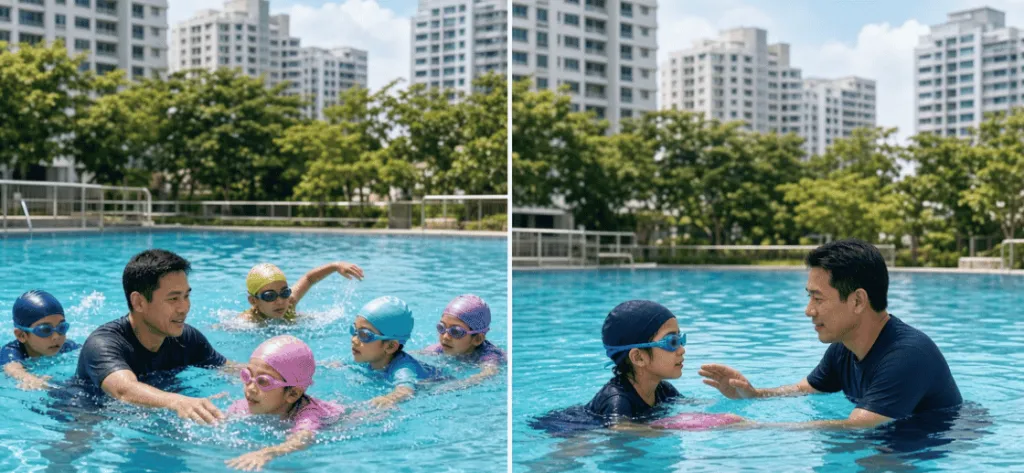
Group swimming lessons are not necessarily an inferior learning experience. While private lessons provide personalised instruction, group lessons offer valuable opportunities for peer learning, social development, motivation and independence. Combining both environments can support a more well-rounded swimming education.
When choosing swimming lessons for their children, many parents wonder whether private or group swimming lessons are better.
Private swimming lessons offer personalised coaching and individual attention, while group swimming lessons encourage peer learning, social interaction and confidence.
But what if the most effective approach is not choosing one over the other?
Combining private and group swimming lessons can provide a more balanced learning experience, helping children develop swimming techniques, confidence, independence and social skills.
At Friendly Dolphin Swim School, we believe both learning environments have unique advantages.
1. The benefits of private swimming lessons
Private swimming lessons provide personalised instruction tailored to the individual student’s abilities, progress and learning needs.
Individual attention
With fewer students, coaches can focus closely on swimming techniques, body positioning, breathing and stroke coordination.
Personalised stroke correction
Private lessons are particularly useful for identifying and correcting individual weaknesses, such as improper freestyle breathing, breaststroke kicking or body alignment.
Flexible learning pace
Every student progresses differently. Private lessons allow coaches to adjust teaching methods and activities based on the swimmer’s confidence and ability.
Confidence building
For children who are initially nervous around water, private instruction may provide a more comfortable environment for developing basic water confidence and swimming skills.
Private lessons are especially valuable when students require focused attention or specific technical corrections.
2. The benefits of group swimming lessons
Although private lessons provide individual attention, group lessons offer learning opportunities that are difficult to reproduce in a one-to-one setting.
Learning through observation
Children can observe how other swimmers perform different techniques and activities.
By watching classmates demonstrate swimming skills, students may develop a better understanding of movements and techniques.
Peer motivation
Children often become more motivated when learning alongside others.
Seeing another student successfully perform a swimming skill may encourage them to attempt the same activity.
Healthy competition
Group swimming activities can introduce friendly challenges that encourage students to improve their swimming abilities, endurance and confidence.
The goal is not simply to swim faster than others, but to develop motivation and recognise personal progress.
Social skills and cooperation
Group lessons encourage students to interact with their classmates, follow instructions, take turns and participate in shared activities.
These experiences help develop communication, cooperation and social confidence.
Independent learning
During private lessons, students may become accustomed to receiving continuous attention from their coach.
In group lessons, they have opportunities to practise independently while the coach supervises other students.
This can encourage students to take greater responsibility for their learning.
Group swimming lessons are not necessarily inferior to private lessons. They provide a different learning environment with valuable educational benefits.
3. Why combining private and group lessons can be better
Private and group swimming lessons complement each other.
Private lessons provide focused technical instruction, while group lessons provide opportunities to practise alongside peers.
For example, a student learning breaststroke may benefit from the following approach:
Step 1: Private lesson — Learn the technique
The coach provides individual instruction on breaststroke kicking, arm movements, breathing and coordination.
Step 2: Group lesson — Practise with classmates
The student practises the techniques alongside other swimmers, observes different movements and participates in suitable group activities.
Step 3: Private lesson — Correct individual weaknesses
The coach identifies technical weaknesses and provides personalised corrections.
Step 4: Group lesson — Build confidence and consistency
The student applies the corrections while practising alongside classmates, gradually improving confidence, independence and swimming consistency.
This approach combines the advantages of both learning environments.
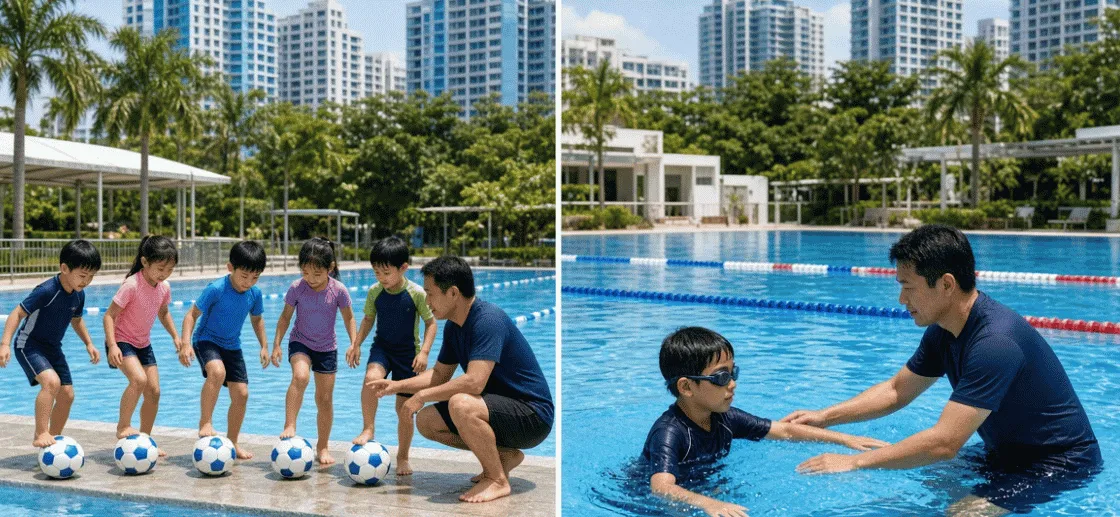
4. Private vs group swimming lessons: A comparison
| Learning factor | Private lessons | Group lessons |
|---|---|---|
| Individual attention | High | Shared |
| Stroke correction | Highly personalised | General and individual feedback |
| Peer learning | Limited | Stronger opportunities |
| Social interaction | Limited | Greater opportunities |
| Healthy competition | Limited | Possible through group activities |
| Learning pace | Personalised | Structured around group abilities |
| Independence | Individual practice | Independent and peer-supported practice |
| Confidence | Personal encouragement | Individual and social confidence |
Neither learning environment is universally better.
The most suitable approach depends on the swimmer’s age, confidence, learning needs, swimming ability and personal goals.
5. Can group swimming lessons sometimes be better than private lessons?
Yes. For certain students and learning objectives, group swimming lessons may provide advantages that private lessons cannot.
For example, a child who already understands basic swimming techniques may benefit from practising alongside other students of similar abilities.
Group activities can encourage greater participation, motivation and confidence.
Similarly, children who are comfortable swimming independently may enjoy the social interaction and variety that group lessons provide.
However, students who require intensive individual attention, have significant water anxiety or need specialised instruction may benefit more from private lessons.
The objective is not to establish that private or group lessons are always superior, but to identify the learning environment that best supports each student’s development.
6. How swimming lesson replacements can provide different learning opportunities
At Friendly Dolphin Swim School, we recognise that outdoor swimming lessons may occasionally be interrupted by adverse weather.
Under our replacement policy, eligible unused teaching minutes can be accumulated and redeemed by joining existing scheduled group classes with available vacancies, subject to the school’s Terms & Conditions.
This means that students attending private lessons may have opportunities to participate in suitable group swimming classes as part of their replacement arrangements.
Besides recovering eligible teaching time, students may experience additional educational benefits, including:
- Observing other swimmers.
- Practising alongside peers.
- Building confidence and independence.
- Participating in suitable group learning activities.
- Experiencing different teaching and learning environments.
A group replacement lesson is not identical to an individual private lesson. However, it can still provide meaningful swimming education when the class is appropriate for the student’s ability and learning needs.
Our objective is to provide reasonable replacement opportunities while maintaining fair and sustainable teaching arrangements for students, parents and coaches.
Students joining group replacement lessons are not necessarily losing out on valuable learning opportunities. Although group lessons provide a different experience from private instruction, they offer additional benefits such as peer learning, social interaction, motivation and independence.
7. Frequently asked questions
No. Private lessons provide greater individual attention, while group lessons offer peer learning, motivation and social interaction. Both can support swimming development.
Some students progress well in group lessons because they are motivated by classmates. Others learn more effectively with individual attention. Progress depends on multiple factors, including practice frequency, confidence and teaching methods.
Yes. A combination can provide personalised technique correction together with opportunities for peer learning, independent practice and social development.
At Friendly Dolphin Swim School, eligible students may join existing group classes for replacement purposes in accordance with our Terms & Conditions, subject to available vacancies and school approval.
The student’s learning needs, water confidence, swimming ability, safety and opportunities for consistent practice are more important than simply choosing private or group lessons.
Conclusion: The best swimming education can combine both approaches. Combining private and group swimming lessons may help students learn more effectively and progress faster by bringing together personalised instruction, peer learning, motivation and independent practice

