

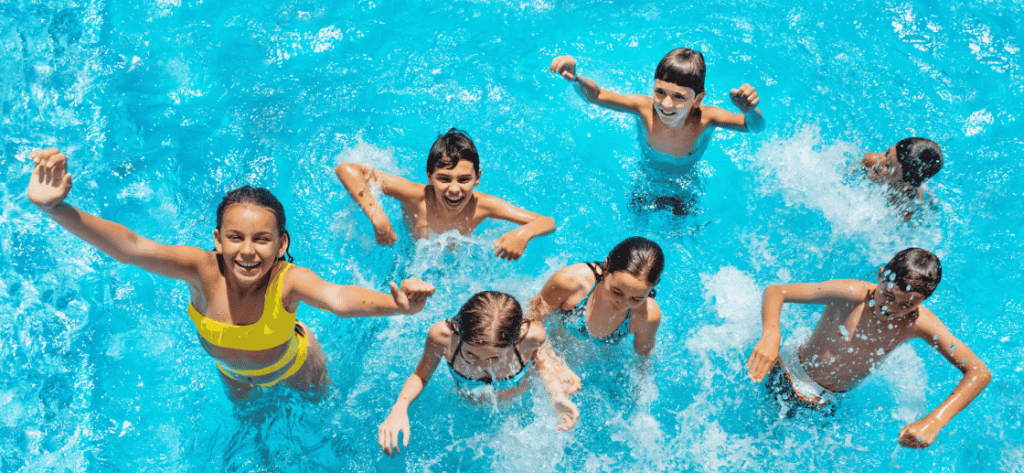
When parents choose swimming lessons for their child, one common question is whether group swimming lessons or private swimming lessons are better for building confidence.
Private lessons provide individual attention and can be very useful for swimmers who need focused coaching. However, for many children, learning in a group offers something equally important: the chance to learn alongside other swimmers.
At Friendly Dolphin Swim School, a supportive group environment can help many children become more comfortable, independent, and confident in the water.
1. Children Learn by Watching Other Children
Children do not learn only from their swimming instructor. They also learn by observing the people around them.
In a group swimming lesson, a child can watch another swimmer:
- put their face into the water
- practice floating
- kick independently
- jump into the pool
- retrieve an object underwater
- attempt a new swimming stroke
When children see someone their age attempting a skill, the activity can seem less intimidating.
A child who initially thinks, “I don’t want to try that,” may become more willing after watching another child complete the activity successfully.
This type of observational learning can make group lessons particularly valuable for building confidence.
2. Group Lessons Create Positive Encouragement
Swimming with other children creates a social learning environment.
When one swimmer completes a new skill, the achievement can encourage others to try too.
Instead of the lesson being only:
coach → swimmer
learning can also happen through:
coach → swimmer → other swimmers
Children can observe, imitate, and encourage one another.
This can gradually help hesitant swimmers become more willing to participate.
3. Children Discover That Making Mistakes Is Normal
In a private lesson, a child receives the instructor’s full attention.
That can be beneficial, but some children may also feel more pressure when every attempt is being watched.
In a group lesson, children see that everyone is learning.
One swimmer may struggle with kicking. Another may need more practice with breathing. Someone else may be learning how to float independently.
Children begin to understand an important lesson:
You don’t have to be perfect to participate.
Mistakes become a normal part of learning, not something to fear.
4. Group Lessons Can Encourage Independence
Private swimming lessons naturally provide more individual assistance from the instructor.
In a group environment, children also have opportunities to wait for their turn, listen to instructions, and attempt familiar skills more independently.
For example, instead of expecting the coach to hold or guide them constantly, swimmers may gradually learn to:
- enter the water independently
- prepare themselves for an activity
- listen and follow instructions
- practice previously learned skills
- wait for their turn
- complete simple swimming tasks independently
This can help confidence develop beyond simply being comfortable with one particular instructor.
5. Confidence Can Become Social
Swimming confidence is not only about being able to perform a stroke.
A confident swimmer may also become comfortable swimming around other people.
Group lessons allow children to practice swimming while sharing the pool with other swimmers. They learn to take turns, respect space, communicate and participate as part of a group.
For children who eventually want to participate in recreational swimming, SwimSafer programs, school activities, or other aquatic activities, these social experiences can be valuable.
6. Other Swimmers Can Provide Motivation
Children often enjoy seeing what their peers can do.
When another swimmer reaches a new milestone, it can provide motivation:
“If they can do it, maybe I can try too.”
This doesn’t need to become unhealthy competition.
The goal is positive motivation.
One child’s progress can encourage another child to challenge themselves, practice harder, and become more willing to attempt unfamiliar skills.
7. Group Lessons Can Make Swimming More Enjoyable
Confidence often grows when children associate swimming with positive experiences.
Learning alongside other children can make lessons feel more social and enjoyable.
You may have opportunities for partner activities, group challenges, games, and shared achievements while still building important swimming skills.
A child who enjoys attending lessons is often more willing to participate consistently.
And consistency is an important part of developing swimming ability and confidence.
Are Private Swimming Lessons Still Beneficial?
Absolutely.
Private swimming lessons and group swimming lessons serve different needs.
Private lessons may suit swimmers who need highly individualized attention, want to improve specific skills, or learn better in a one-to-one environment.
Group lessons may be particularly valuable for swimmers who benefit from peer observation, social interaction, shared learning and positive encouragement.
No single lesson format is best for every swimmer.
The best option depends on the swimmer’s age, personality, current ability, learning needs, and goals.
Building Confidence One Lesson at a Time
Confidence in swimming usually does not appear overnight.
It develops through repeated positive experiences:
observe → try → practise → improve → succeed → gain confidence
Group swimming lessons provide children with opportunities to experience this process alongside other swimmers.
They can watch others try, attempt skills themselves, make mistakes, improve, and eventually become examples for newer swimmers.
At Friendly Dolphin Swim School, our goal is not simply to teach children swimming techniques. We want swimmers to become safer, more independent, and more confident in the water.
Whether your child is taking their first steps into the pool or developing their swimming strokes, a supportive group environment can make learning swimming a positive and rewarding experience.

